Hello folks,
This page is dedicated to business-focused content, with regular updates on international relations, technological advancements, business aspects, current affairs, and much more. If these topics interest you, make sure to subscribe and stay updated—you won’t want to miss what’s coming next.
In today’s topic we’ll understand about inflation, and What the New CPI Framework Means for Inflation in India from the very basics. I will give you one example about inflation. When I was in 4th class, I used to travel to another city for my school, and the KSRTC bus charges were ₹4 for children and ₹7 for adults. Now that price, after 12 years, has become almost ₹20 per person. Just imagine the rising prices. The same goes for other products like food, groceries, etc.
Inflation simply means reducing the power of money, and on average India’s inflation is rising at a 3.5–4% rate.
There are two different measures for calculating inflation:
- Headline inflation
- Core inflation
Headline inflation measures total inflation, and it includes all items like food, fuel, housing, rent, transport, and all other consumer goods and services. Whereas core inflation measures inflation without considering the inflation related to food and fuel prices.
Both have their own importance, but core inflation is mainly used in making decisions related to government framework and policies.
Let’s understand how it works. In order to understand inflation, you must know CPI (Consumer Price Index). It helps to measure the average change in the price of goods and services over a period of time.
Let’s say CPI was 100 last year and now it has increased to 105, which means prices increased by 5%. Inflation is 5%.
You might be a bit confused about how CPI is calculated. CPI consists of food, transport, housing, clothing, education, healthcare, etc. It is generally calculated based on the base year prices of 2012, which is considered the base year, and inflation is calculated based on that standard year.
But the major flaw in using this system is that earlier, in 2012, customers’ major spending was related to food and necessary items, but now the spending is more on housing, transport, luxury goods, technology, etc.
Consumption patterns have evolved over a period of time, but the government policy and framework did not. Due to this, we have seen inflation rising at a faster rate.
Honestly speaking, calculating inflation is not an easy task. Consumption patterns are changing, spending habits of consumers are evolving. You can ignore some things up to a limit, but if the difference becomes large, the government needs to act on it. Which is why the old inflation framework itself had to be replaced.
This replacement came in early 2026, in the month of February. Now India has started publishing its inflation numbers and other statistics based on the 2024 CPI index. That means now India is taking 2024 as the base year for calculation of inflation.
If you ask why change the base year? Is it really necessary? Of course, it is very necessary. Inflation should be calculated based on the normal spending of individuals. If you calculate inflation based on outdated data, then the inflation data makes no sense. It becomes hard for economists or businessmen to take proper decisions in their respective fields.
So let’s compare the 2012 and 2024 CPI index weightage
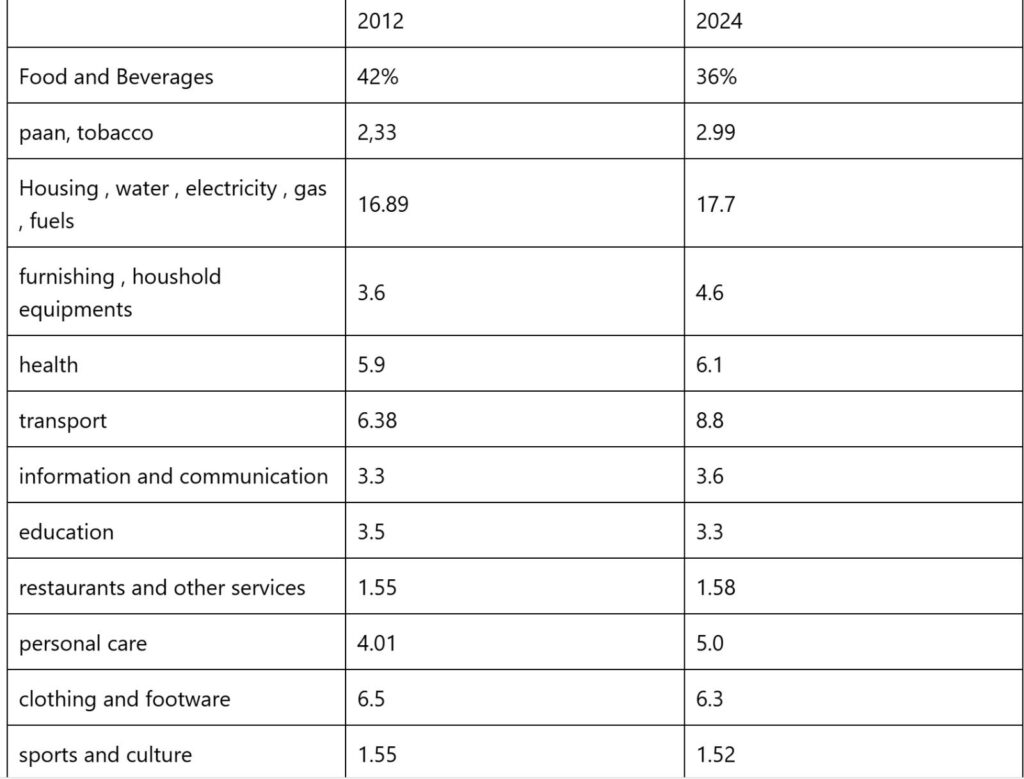
Now after the change in the framework, inflation may start acting slightly differently. Sudden spikes in food prices may not swing headline inflation as it used to before. Rent, transport, and consumer goods inflation rise slowly and steadily, and through this approach inflation readings are 2.73% in rural and 2.77% in urban areas.
what do you know about orange economy ?https://dailyvichara.com/what-is-orange-economy-you-need-to-know-about/